TMJ treatment in Uzbekistan
Prices from 500 000 UZS. Book online — instant request number, free.
- Free
- Instant request number
- 1455 clinics in the catalog
- Clicking, grinding, or pain in the joint when opening the mouth or chewing
- The mouth does not open fully or the jaw periodically locks
- Frequent headaches or pain in the temples, ears, or facial muscles
- Teeth grinding during sleep (bruxism) or a habit of strongly clenching the jaw
- Misaligned bite or jaw discomfort after trauma, stress, or long dental procedures
Online booking
Book online: tmj treatment
Pick a day and time — you get a request number instantly.
We match a clinic and call you back
Choose a time- Free
- Instant request number
- Telegram reminder
TMJ treatment is a set of conservative and, when needed, surgical methods aimed at correcting problems in the temporomandibular joint and the muscles that move the lower jaw. It is done to reduce pain and clicking when opening the mouth, limited jaw movement, headaches, and the effects of teeth grinding (bruxism), helping restore normal chewing function. The treatment plan is tailored to each patient based on diagnostic findings and depends on the specific case.
- 1
Consultation and examination
The doctor reviews your symptoms and checks jaw movement, bite, and the joint muscles.
- 2
Diagnosis and imaging
When needed, X-ray, CBCT, or MRI is used to clarify the condition of the joint.
- 3
Conservative treatment
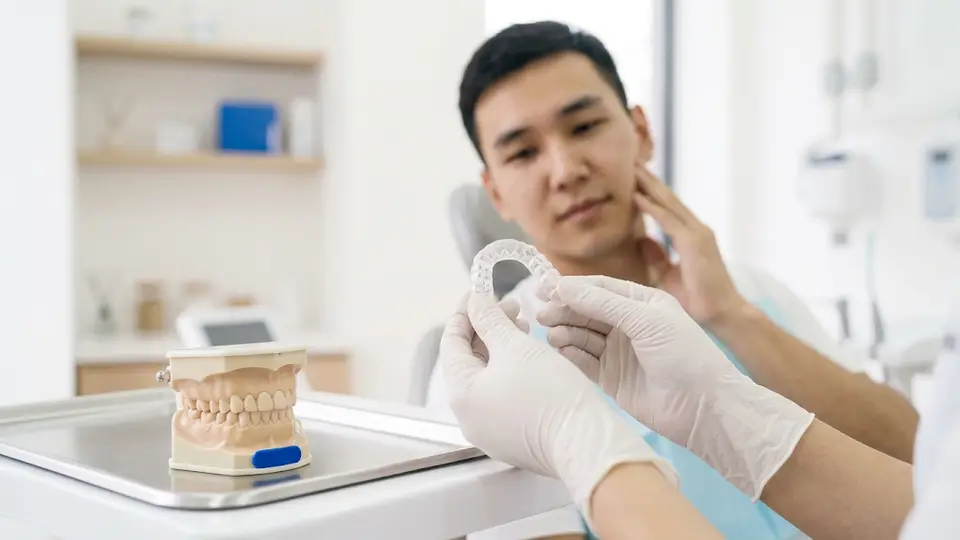
Most cases start with splints, physiotherapy, exercises, and medication.
- 4
Additional procedures
If conservative methods are not enough, injections or minimally invasive procedures are considered.
- 5
Follow-up and result
Follow-up visits assess progress and monitor chewing and pain symptoms.
- Check that the clinic has a specialist who treats TMJ — a gnathologist or maxillofacial surgeon
- Look for on-site diagnostics such as X-ray, CBCT, or access to MRI
- Ask whether the plan is explained step by step and whether conservative methods are offered first
- Make sure cost, expected stages, and follow-up visits are explained transparently in advance
Choose a clinic
Pick a clinic for TMJ treatment — 1455 clinics in the catalog.
FAQ
Is TMJ treatment painful?
Most methods — splints, physiotherapy, exercises — are painless. If injections or surgery are needed, anesthesia is used.
How long does treatment take?
Duration depends on the case: a few weeks for mild forms and several months for chronic ones.
Can it be treated without surgery?
Usually yes — conservative methods help most patients, and surgery is considered only in some severe cases.
What examinations are needed for diagnosis?
Usually a clinical exam combined with X-ray or CBCT, and sometimes MRI to assess soft tissues.
What is the starting price?
Prices start from 500,000 so'm and depend on the chosen diagnostic and treatment methods.
Can symptoms come back after treatment?
Yes, if stress, bruxism, or bite problems persist; that is why follow-up visits and following recommendations matter.