CBCT 3D scan in Uzbekistan
Prices from 150 000 UZS. Book online — instant request number, free.
- Free
- Instant request number
- 1455 clinics in the catalog
- Before an implant — to assess bone volume and quality
- When planning a complex or impacted extraction, such as a wisdom tooth
- For root-canal retreatment and to find hidden areas of inflammation
- For bite anomalies and orthodontic planning (braces, aligners)
- To examine the sinuses, jaw joint (TMJ) or jaw trauma
Online booking
Book online: cbct 3d scan
Pick a day and time — you get a request number instantly.
We match a clinic and call you back
Choose a time- Free
- Instant request number
- Telegram reminder
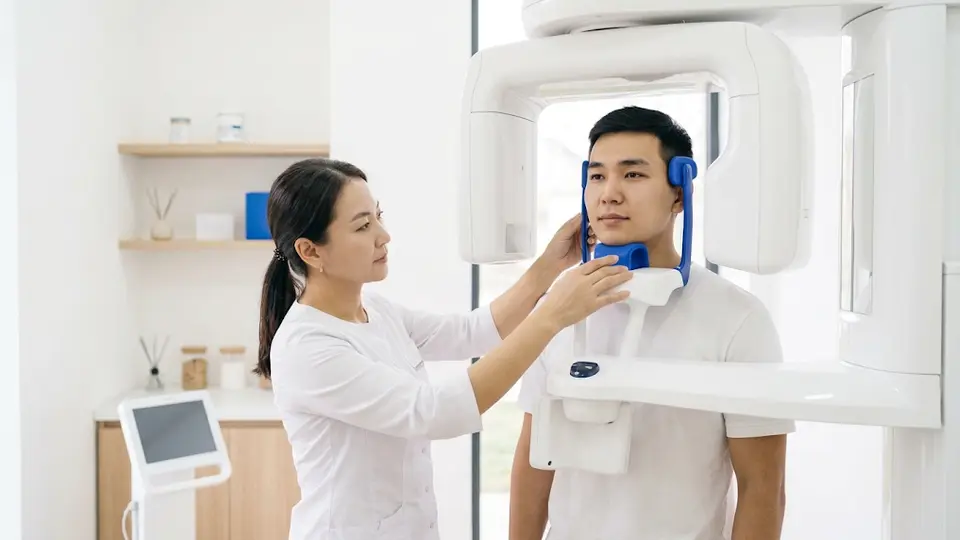
A 3D cone-beam CT (CBCT) is a modern dental imaging method that captures a volumetric X-ray of the jaws, teeth, sinuses and jaw joints in just a few seconds. Unlike a standard panoramic image, it shows bone and tooth roots in every plane, which is why it is used to plan dental implants, complex extractions and root-canal treatment. The scan is usually done in a single short rotation, and the radiation dose is lower than that of a medical CT.
- 1
Consultation and referral
The dentist reviews your concern and decides which area — a single tooth, a jaw, or the whole skull — needs to be scanned.
- 2
Preparation
You remove metal items (earrings, jewellery, removable dentures) and put on a protective apron.
- 3
The scan
You stay still while the machine makes one rotation around your head, capturing the image in a few seconds.
- 4
Processing and result
Software reconstructs the 3D model, and you receive the result on a disc, via a link, or as a printout.
- 5
Doctor's interpretation
Your treating dentist studies the image, confirms the diagnosis and explains the next treatment steps.
- Scanner type and field of view (FOV): a small FOV for one tooth, a larger one for implants or a full jaw.
- Whether you get a radiologist's report and a file format (DICOM) that other clinics can open.
- Availability of low-dose modes, especially for children and repeat scans.
- What the price includes: just the scan, or also the doctor's report and a digital copy.
Choose a clinic
Pick a clinic for CBCT 3D scan — 1455 clinics in the catalog.
Clinics offering CBCT 3D scan
List compiled from 2GIS/OpenStreetMap categories and names — confirm the service and price with the clinic.
FAQ
Is a CBCT harmful, and how high is the radiation dose?
The dose from a CBCT is significantly lower than a medical CT, and the scan is done only when clinically indicated, so the risk is minimal when used reasonably.
How long does the scan take?
The scan itself usually takes 10-30 seconds, and with preparation the whole visit is over in a few minutes.
Do I need to prepare?
No special preparation is needed; you only remove metal jewellery and any removable dentures.
Can a CBCT be done during pregnancy?
During pregnancy a CBCT is usually postponed and done only in urgent cases after consulting your doctor; always tell the staff if you may be pregnant.
Can I use the result at another clinic?
Yes, the result is usually provided in the standard DICOM format on a disc or link, so you can share it with any dentist.
How is a CBCT different from a regular X-ray?
A regular X-ray gives a flat 2D image, while a CBCT shows the area in three dimensions and lets the dentist assess bone, roots and canals far more precisely.