Zygomatic Implants: When Standard Implants Are Not an Option
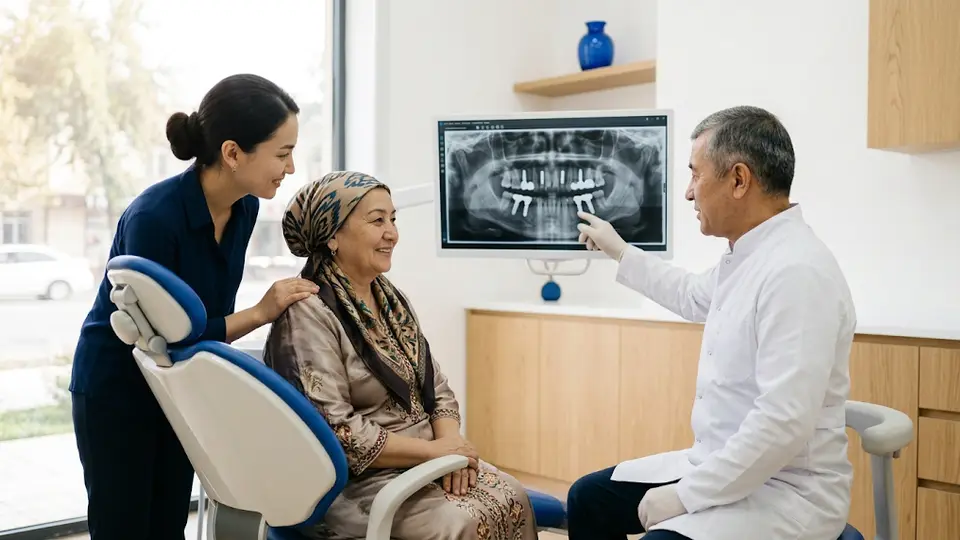
Zygomatic implants are fixed into the zygomatic (cheek) bone rather than the alveolar ridge, and they are used when the upper jaw no longer has enough bone volume to support conventional implants. This situation most often arises after years of tooth loss, severe periodontitis, or following oncological surgery. In Tashkent, the implant itself costs from 3 to 12 million soum, and a complete turnkey protocol — implant, abutment, and crown — runs approximately 4.5–28 million soum, with zygomatic cases generally sitting toward the higher end of that range. Only a specialist can give you a precise figure after reviewing your CT images.
Standard dental implants depend on adequate bone height and density in the jaw ridge. When the upper jaw has atrophied significantly — especially in the posterior regions where the floor of the maxillary sinus drops low — a conventional implant has nowhere to grip. Until zygomatic implants became available, the only path forward was multi-stage bone grafting or sinus lifting, stretching treatment out by a year or more. A Zygoma implant, typically 30–50 mm long, bypasses this problem entirely by anchoring in the cheekbone, which retains its density even when the jaw has resorbed severely.
The Zygoma protocol is generally indicated for Class III–IV maxillary atrophy (Cawood & Howell classification), failed conventional implants with significant bone loss, post-oncological jaw defects, and certain congenital conditions. The surgeon evaluates all of this through cone-beam CT (CBCT). If bone loss is only moderate, the clinician may instead recommend a sinus lift (from 3 to 6 million soum) or guided bone regeneration (from 2.5 to 7 million soum) as simpler alternatives — a conversation worth having before committing to any protocol.
Choosing the right surgeon matters enormously here. Placing zygomatic implants is technically far more demanding than routine implant surgery: the orbital nerve and sinus structures lie in close proximity to the surgical field. The surgeon should have documented experience specifically with Zygoma protocols and should work in a facility equipped with modern navigation systems or surgical guides. Ask directly about the number of cases performed and the clinic's complication-management protocol — a reputable team will answer those questions without hesitation.
Recovery after zygomatic implant placement typically follows a staged approach. In most cases a temporary prosthesis is loaded on the day of surgery or shortly after, which is a meaningful advantage for patients who have been completely edentulous in the upper jaw. That said, dietary restrictions and load limitations apply during early healing, and following your surgeon's instructions closely has a direct impact on the outcome. If you notice facial swelling, fever, or difficulty swallowing after the procedure, contact your clinic immediately — these symptoms require prompt attention.
The Dentum catalogue lets you compare Tashkent clinics by rating, specialisation, and patient reviews without spending hours making phone calls. If a surgeon has mentioned zygomatic implants as a possibility for you or a family member, it is worth consulting at least two or three clinics and comparing the proposed treatment plans. Book an initial consultation and CT scan: only after seeing the images can a specialist determine whether zygomatic implants are truly necessary in your case, or whether a less complex protocol would achieve the same result.
How are zygomatic implants different from regular dental implants?
Standard dental implants are placed in the alveolar bone of the jaw and require sufficient bone volume to achieve stable osseointegration. Zygomatic implants are considerably longer and anchor into the cheekbone — a dense structure that remains intact even when the upper jaw has resorbed severely. In many clinical situations this makes it possible to avoid multi-stage bone grafting altogether.
Is a CT scan always required before zygomatic implant surgery?
Yes, cone-beam CT (CBCT) is mandatory before any Zygoma protocol. Only a three-dimensional scan allows the surgeon to assess the exact bone volume available, map the position of the maxillary sinuses and orbital structures, and plan the precise implant angle. If a clinic proposes skipping CT diagnostics, that is a serious red flag about their competence.
How much does zygomatic implant treatment cost in Tashkent?
The cost depends on the clinical situation, the number of implants required, and the type of final prosthesis. As a general guide, the implant itself ranges from 3 to 12 million soum, while a comprehensive turnkey protocol runs from approximately 4.5 to 28 million soum and above. A precise figure can only be given by a specialist after an in-person examination and CT review.
What complications are possible after Zygoma implant surgery?
As with any surgical procedure, potential complications include infection, altered sensation in the cheekbone or upper lip area, and sinusitis. These risks are substantially reduced when the surgeon has specific experience with Zygoma protocols and the patient follows all post-operative instructions carefully. If facial swelling, fever, or difficulty swallowing develop after surgery, seek medical attention immediately.
Online booking
Book an implant consultation
Pick a day and time — you get a request number instantly.
We match a clinic and call you back
Choose a time- Free
- Instant request number
- Telegram reminder