Dental Bridge vs Implant: Cost Comparison and Long-Term Consequences
When a tooth is lost, a dentist typically presents two main options: a dental bridge or an implant. At first glance, a bridge seems like the obvious choice — it costs less, goes in faster, and requires no surgery. But that simplicity comes with a price that many patients only recognize years down the line.
A dental bridge is anchored to two neighboring teeth, which serve as its supports. To fit the crowns properly, those teeth must be ground down — about 1.5 to 2 mm of enamel is removed all the way around. Even if the adjacent teeth are completely healthy, they become permanently vulnerable after preparation. Statistics show that within 10 years, roughly 15% of bridge abutment teeth require root canal treatment or extraction. So in solving one missing tooth, the patient risks losing two more.
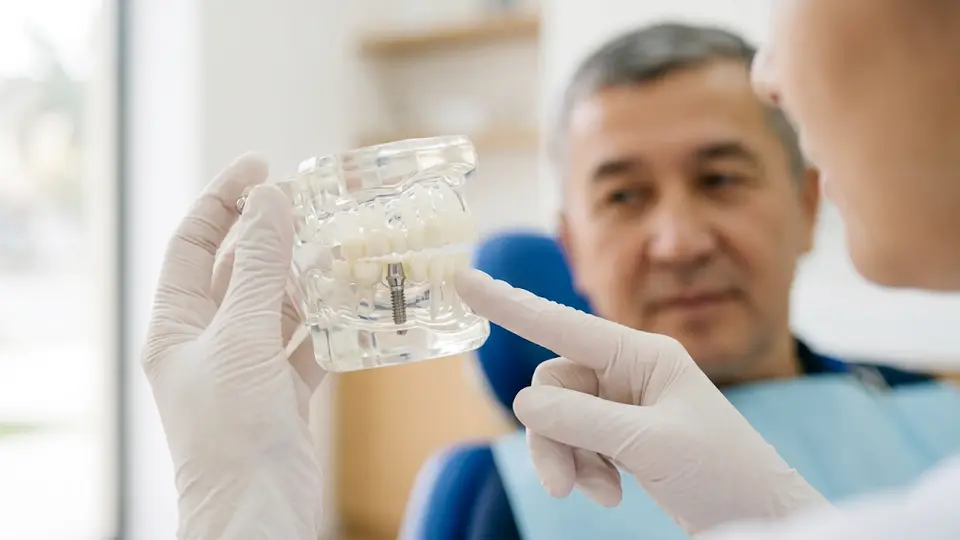
An implant works differently: a titanium post is placed directly into the jawbone and bears the load on its own. The neighboring teeth are left completely untouched. The bone around the implant is preserved — and even stimulated by chewing forces — unlike the area beneath a bridge, where bone gradually resorbs due to the absence of a root.
Now for the numbers. In Tashkent, a three-unit bridge typically costs significantly less upfront than an implant with a crown. But the math has to be done over time. A quality bridge typically lasts 10–15 years, after which the whole structure is replaced — and the abutment teeth are ground down again. An implant, with proper care, lasts a lifetime; only the crown needs replacing, roughly every 15–20 years. When you factor in total spending over 20–30 years — including potential treatment of the support teeth — the implant often ends up being economically comparable, or even the better deal.
When is a bridge the right call? First, when the neighboring teeth are already heavily damaged or restored and will need crowns regardless — in that case, a bridge fits naturally into the treatment plan without sacrificing anything extra. Second, when there isn't enough bone volume for an implant, and bone grafting would significantly increase both cost and treatment time. Third, when surgery is contraindicated: certain systemic conditions, anticoagulant therapy, or active oncology treatment.
Clinics in Tashkent offer bridges in metal-ceramic, zirconia, and pressed ceramic. During the initial consultation, the prosthodontist evaluates the condition of the adjacent teeth, takes an X-ray, and gives you an honest assessment of whether grinding them down makes clinical sense — or whether implantation is worth exploring. No upselling, just clinical reasoning.
The bottom line is straightforward: if your neighboring teeth are healthy, think of an implant as an investment in keeping them that way. If those teeth already need crowns, or your budget is tight right now, a well-made bridge placed by an experienced prosthodontist remains a reliable solution. What matters most is making that decision with a clear understanding of the long-term consequences.
Does it hurt to have teeth ground down for a bridge?
The procedure is done under local anesthesia, so there's no pain during preparation. Some mild sensitivity for 1–3 days afterward is normal and easily managed with over-the-counter pain relievers. If the teeth have already had root canals, discomfort is minimal.
How long does a dental bridge last?
With quality craftsmanship and consistent oral hygiene, a metal-ceramic bridge typically lasts 10–15 years; a zirconia bridge can last up to 20 years. Lifespan shortens with poor hygiene in the space under the bridge, bruxism, or untreated decay on the abutment teeth.
Can I get an implant after I've already had a bridge placed?
Yes — a bridge can be removed and an implant placed, but only if enough bone volume remains underneath. The longer a bridge sits without a root in the socket, the more the bone resorbs, and the more likely a bone graft will be needed first. That's why it's better to make the implant decision as early as possible.
Which is ultimately cheaper — a bridge or an implant in Tashkent?
A bridge costs less upfront. But over a 15–20 year horizon, the gap narrows: the bridge will need to be replaced, and the abutment teeth may require additional treatment. An implant with a crown is a one-time investment with minimal ongoing costs. Exact figures depend on your specific clinical situation — find out more at a free consultation at Dentum.
Online booking
Book online: dental bridge
Pick a day and time — you get a request number instantly.
We match a clinic and call you back
Choose a time- Free
- Instant request number
- Telegram reminder